It’s 11:30 p.m. on a Tuesday night. The kids are finally fast asleep down the hall, and as a single mom, you have exactly two quiet hours to finish an urgent work proposal before tomorrow morning's deadline. You set up at the kitchen island with the laptop open and the tea steaming. Then you spot the problem. The nearest free outlet sits across the main walkway. So you do what any deadline-chasing parent would do and stretch a thick black extension cord across the floor.
Congratulations, you’ve built a booby trap.
Here’s the thing about that cord. It looks ugly, sure, but it also waits patiently in the dark. One half-asleep toddler shuffles in for a glass of water, catches a foot on it, and down it all comes: the laptop, the hot tea and maybe a spark from the socket. That’s a plot twist your proposal never needed.
Sound familiar? Why does a simple bit of light have to be this annoying?
Moments like that help explain why cordless lighting keeps growing. HTF Market Report shows the global rechargeable table lamp market reaching $1.8 billion in 2025 and expanding at an 11.10% CAGR through 2033. Meanwhile, Fortune Business Insights adds that the broader smart lighting sector is heading to $34.26 billion in 2026.
More people are cutting the cord, and a night like this one shows why. A portable rechargeable lamp skips. the whole problem. It holds its own power, so the light goes wherever you go, SIMPLE!
Grab that tea. As below, you'll see how these lamps work, how to charge one, and a few honest limits, because no lamp is perfect, and knowing that before you buy saves you from the classic "why did I order this?" moment.
What Is a Portable Rechargeable Lamp?
Okay, quick quiz. What's the one thing a regular lamp can never do? Well, leave the wall!
But a portable rechargeable lamp can because it carries a battery inside. You charge it up through a USB cable, and then it’s free. Meanwhile, a plug-in lamp stays tied to its outlet for life, like a dog on a very short leash.
So picture a Tuesday, the lamp starts on your dresser, joins you at the dining table for dinner, and ends the night on the balcony with you and a cup of tea. Nothing gets unplugged, and nothing trails across the floor.
That freedom to move is the whole point, and it’s why one small light can change how a room works.
It also suits how people live and decorate now. Inprint Designs reports that 72% of the population in EU cities lives in a flat, based on Eurostat’s Housing in Europe 2024, and that 84% of homeowners in a Houzz survey named personal taste as one of the biggest drivers of their decorating decisions.
Smaller spaces and strong opinions both call for a lamp you can move.
How Does a Portable Rechargeable Lamp Work?
It’s 8pm and the lamp’s battery is nearly empty. No problem!
You plug in a USB cable before bed; the battery refills overnight, and by morning the lamp holds a full tank of energy. When you tap the switch that evening, the battery powers the LED and the room glows. You charge it once and enjoy it for hours.
No wall, no wiring, and no drama. It’s as simple as:
USB-C cable → lithium-ion battery → LED → warm glow anywhere
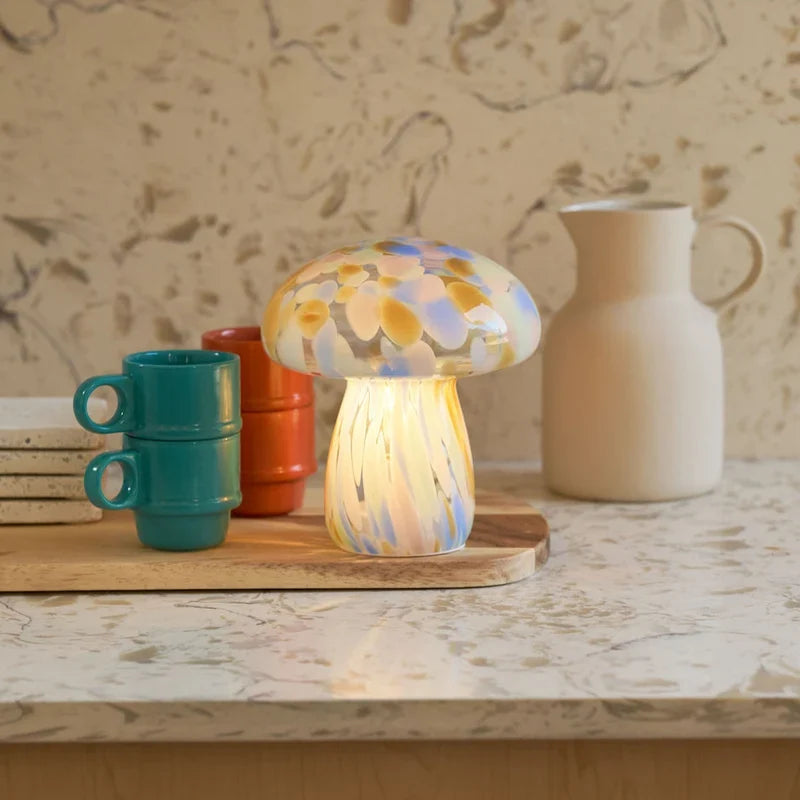
The LED deserves a little credit. It uses so little power that a small battery can run it through a whole evening. Let’s take the viral glass mushroom lamps by Shop Humber, which use a 0.5W LED and a touch button for two brightness levels, 100% and 30%.
Tap once for movie night. Tap again for dinner. Enjoy hours of cord-free warmth at a single touch!
What Are the Main Parts of a Portable Rechargeable Lamp?
Whatever the style, inside every rechargeable and portable lamp fixture are a few basic components that work together behind the scenes. Knowing them makes shopping a lot easier:
- Lithium-ion Battery: Stores electrical energy safely in a compact frame
- LED Bulb: Produces bright illumination while drawing low power and staying cool to the touch
- USB-C Charging Port: Connects to a standard phone charger for quick power top-ups
- Touch Button: Dimmer control switch that adjusts the brightness with a simple tap
- Outer Body: Protects internal electronics using solid metals or thick glass
How Do You Charge a Portable Rechargeable Lamp?
Imagine settling in to charge your lamp on a scorching summer afternoon. Setting your lamp on a sun-drenched window still might seem convenient, but extreme heat is actually a battery's worst enemy! Phew, taking an extra second to pick a cool, shaded counter keeps your lamp glowing for years to come.
The science behind heat degradation is super clear. Battery University reports that a lithium-ion battery stored at full charge at 25°C recovers about 96% of its capacity after a year, compared with 85% at 40°C temperature. Keeping your lamp away from direct sunlight during charging prevents heat buildup from wearing down the internal power cell.
To top up your light safely, keep these quick tips in mind:
- Check the cable fits securely first
- Use standard five-volt wall chargers
- Watch the status indicator change color
- Avoid hot sunny charging spots
- Unplug promptly when fully charged
How Long Can a Portable Rechargeable Lamp Stay On?
Here’s a question that comes up after the first week with a new lamp: how long does the glow last? Your phone gives you a clue. Run it at full brightness and the battery melts. The lamp works the same way. Ugh, maxing it out for no reason means you’ll be digging for the charger by Thursday. Turn it down at bedtime and a few hours of light a night can stretch for days.
Models differ, since design and battery size change everything. Quality portable lamps generally give around 10-12 hours of warm ambient light per charge. For instance, a popular glass mushroom-style lamp can run up to 12 hours on high after a 4-hour charge, and a compact mini lantern gives 10 hours or more, whatever brightness you pick.
Now, the honest bit. Lithium batteries don’t live forever. Battery University notes they’re typically rated for 300 to 500 charge cycles. Plug in daily, and you’ll get about ten to sixteen months before the capacity starts to taper off. Charge every few days, though, and the battery will last a lot longer.
What Are the Benefits of Using a Portable Rechargeable Lamp?
Think about the last time you moved the TV stand. Behind it, a nest of dusty cords, a lost remote, and at least one sock. Nobody misses that mess, right? A rechargeable lamp skips the knots entirely. It glows on your shelf with no wire dangling down the baseboard, and the room feels calmer for it.
People are catching on to cordless living in a big way. Transparency Market Research valued the global cordless appliances market at US$41.4 billion in 2022 and projected US$77.2 billion by 2031 in an August 2023 report. Lamps are a small part of that, but the habit is the same. Here’s why people like them:
- Light Wherever You Want It: Put the lamp on any table, shelf, or sill
- Easy Carrying: Take it with you from room to room
- Simple Charging: A USB cable and a few hours do the job
- Furniture Freedom: Rearrange the room without hunting for sockets
- Clear Floors: No wires for guests to trip over
- Good Looks Even When Off: The lamp doubles as a small sculpture on the table
Where Can You Use a Portable Rechargeable Lamp?
Almost anywhere.
Think about all those awkward dark zones in your home that sit in shadow simply because baseboard plugs were placed twelve feet away. Adding a portable light restores cozy warmth while protecting your rest.
Think about what happens after the lights go out downstairs. You’re winding down, the screen goes off, and you reach for a lamp. That choice matters, as one study revealed that 6.5 hours of blue light shifted circadian rhythms by 3 hours, compared with 1.5 hours for green light. A warm, low glow keeps the evening calmer, and a portable lamp makes that easy.
You can drop these wireless fixtures into all kinds of fun, high-impact spots:
- Living Room Coffee Tables: Picture the lamp in the middle of the room on a rainy Sunday, with blankets, snacks and no cord in sight
- Bedside Nightstands: Keep the table tidy and take the lamp along when you stumble to the kitchen for water
- Dining Room Sideboards: A soft glow behind a spread of food makes dinner feel like an occasion
- Entryway Console Tables: Switch it on before guests arrive so the first thing they see is a warm welcome
- Cozy Reading Corners: The lamp sits by your armchair for a quiet chapter, and a brighter light may suit longer sessions
- Patio Dining Tables: Choose a weather-rated lamp, set it on the table for outdoor meals and bring it in afterwards
- Entertaining Spaces: Move the lamp from room to room as the party shifts, so the mood follows your guests
How Can Portable Rechargeable Lamps Work in Small Apartments and Condos?
Quick question. When was the last time you counted the outlets in your condo? Most people in downtown Mississauga can name them all, because there aren’t many. One has the TV, one has the router, and one is hiding behind the sofa. A floor lamp wants a fourth, plus a corner you don’t have. That’s the moment a cordless lamp starts to look smart.
Here’s the bigger picture. Statistics Canada reports that apartment-type homes were 34.8% of Canadian dwellings in 2021. Apartments in buildings of five or more storeys grew 14.7% from 2016 to 2021, against 4.4% for single-detached houses. Condos are multiplying, and the sockets aren’t.
A portable lamp gets around all that. Put it on a narrow windowsill by day and move it to the bookshelf at night. If you’re cooking, it can ride along on the counter. It’s one lamp doing the work of three, and none of them need a plug.
Can Portable Rechargeable Lamps Be Used Outdoors?
It’s a warm July evening, you’re out on the balcony with something cold in your hand, and the sky is doing its pink thing. Then it gets dark. Dragging a cord out through the sliding door means one more thing to trip on, so most people just sit in the dark.
A portable lamp changes that by bringing the cozy indoor glow outside, and the door closes properly.
Still, check before you carry one out. A covered porch is a very different place from an open patio in the rain, and the product specs tell you which one the lamp can handle. Look for a splash-proof rating, such as IP44. There’s also a safety angle, as Health Canada estimates nearly 800 candle fires a year in Canada between 1999 and 2008, and a flameless lamp skips that risk.
A flameless LED lamp gives you the mood without the flame and especially at:
- High-Rise Balconies: Gentle evening light where no outlet exists
- Patio Dining Tables: A centrepiece with no wax to drip
- Backyard Gatherings: A soft glow that welcomes guests to the table
Portable Rechargeable Lamps vs Plug-In Lamps: What Is the Difference?
Say you’re deciding between two lamps for the same corner. One needs a wall socket, and the other carries its own power. That one difference changes where the lamp can sit and how long it can stay on. A cordless lamp will happily follow you from the sofa to the balcony, while a plug-in lamp is happier staying put all day. Here’s how they stack up:
| Feature | Portable Rechargeable Lamps | Traditional Plug-In Lamps |
|---|---|---|
| Power Source | Internal rechargeable lithium battery cell | Continuous flow of electricity from the home grid |
| Portability | Moves anywhere in seconds | Stays near an outlet |
| Placement | Unlimited; place anywhere regardless of outlet locations | Restricted to areas within a few feet of a wall socket |
| Charging Requirements | Needs a recharge after hours of use | Runs indefinitely as long as electricity flows |
| Continuous Operation | Runs for the battery's charge | Runs as long as it's plugged in |
| Cable Clutter | Zero wires during daily use for clean surfaces | Permanent power cords snaking down walls or furniture |
| Ideal Use Case | Multi-purpose rooms, outdoor decks, and central tables | Fixed reading desks or permanent bedside installations |
What Features Should You Look for in a Portable Rechargeable Lamp?
Imagine unboxing a sleek new table light, placing it on your desk, and watching it fizzle out thirty minutes later. Ugh!
Or picture falling in love with a wireless lamp online, only to discover it uses a strange charging cable that doesn't fit any plug in your house. Matching a lamp's technical features to your daily routine makes all the difference!
Double-check these core details before clicking buy:
- Verify actual battery runtime metrics.
- Prefer standard universal USB-C ports.
- Match cables with owned tech.
- Pick built-in or swap-out batteries.
- Choose smooth touch dimming controls.
- Invest in heavy metal construction.
- Pick lightweight single-handed lifting designs.
- Check lumen output for tasks.
- Confirm indoor or outdoor suitability.
How Can Portable Rechargeable Lamps Enhance Home Decor?
Let’s talk looks!
Here’s something decorators know: "a good lamp is half decor and half light!" Without a cord dangling from the table, the lamp finally gets its moment. Think of a rounded glass shade next to a vase, or a slim metal base by a stack of magazines. It looks like it belongs there, because it does.
Pooky founder Rohan Blacker explained why people are into this in Business of Home: “You had candlesticks and oil lamps that you would carry with you or place anywhere that made sense. With the adoption of electricity, lighting was constricted to the edges of the room or overhead.” Rechargeable lamps, he added, let people “once again put lighting wherever you want it.”
So play with materials. A metal finish, a frosted glass shade or a natural wood base each add their own texture beside your existing furniture. And that dark corner? Put a small lamp there. It draws the eye across the room, and a compact space starts to feel warmer and more open.
How to Choose the Right Portable Rechargeable Lamp for Your Space
You know the classic mistake.
We have all bought home decor purely because it looked cute in a photo, only to realize it completely fails in real life. Yikes, nobody wants a stylish table light that acts more like a glorified paperweight because the battery dies after twenty minutes!
Sifting through specs does not have to be a headache if you know what order to follow. Here is a quick, foolproof game plan to help you pick a keeper on the first try:
- Pick the Spot: Know primary indoor outdoor locations.
- Decide the Purpose: Choose soft mood task lighting.
- Measure your Surface: Leave room for drinks books.
- Check Portability: Ensure easy one-handed carrying.
- Check the Brightness: Verify lumens for relaxed reads.
- Look at Charging: Match USB cables daily routines.
- Match your Decor: Select shapes colors complement styling.
Explore Portable Rechargeable Lamps for Flexible Home Lighting
So, that’s the whole story!
A rechargeable lamp holds its own power, charges through a USB cable and goes wherever the evening does, from bedside tables to balconies and the tight corners of small apartments. The trick is to decide where it will live, then check the runtime, charging and build against that spot. Do that, and the lamp earns its keep.
If you want a place to start, Shop Humber is worth a look. Picture a small shop whose tagline is Curating Everyday Space, where every glass lamp is made by hand and arrives with its own quirks. The mushroom lamps are the stars of the show, glowing for around 10 to 12 hours on a single charge, according to the collection. Not bad for something that fits on a shelf.
- Rechargeable through USB-C, with touch-dimming on selected models
- Handmade glass mushroom lamps rated IP44 splash-proof and tagged Outdoor Friendly
- Prices starting at just $65 CAD
Curious which one suits your corner? See the portable rechargeable lamps and pick your favourite.
Frequently Asked Questions (FAQs)
Q1. How do cordless rechargeable lamps work?
Think of your phone. The lamp does the same job, only with a light instead of a screen. A USB cable charges a lithium-ion battery, then the battery feeds an LED every time you switch it on. Shop Humber’s lamps use USB-C and a touch button to step through brightness levels, so one lamp handles both dinner and bedtime.
Q2. Can you leave a rechargeable lamp plugged in all the time?
Say you charge the lamp every night and forget about it. Usually that’s fine, but heat is the catch. Battery University says a lithium-ion battery kept at full charge at 25°C recovers about 80% of its capacity after a year, compared with 96% at 40% charge. So unplug it once it’s full, keep it off hot windowsills, and check your lamp’s manual, since models differ.
Q3. How long do portable lamps take to charge?
Plug it in before bed and unplug it in the morning, and you’re covered. Charge time depends on the battery size and the charger. Shop Humber says a full charge takes about 4 hours on its glass mushroom lamps, and the adapter isn’t included, so a spare phone charger does the job. A full battery can then run up to 12 hours at the brightest setting.
Q4. Can you put a rechargeable light bulb in any lamp?
Not always. You’re standing in a store with a rechargeable bulb in hand, so check three things first. The socket size has to match, and many lamps in North America use a standard medium base. Check the lamp’s wattage limit, and avoid fully enclosed shades, where heat builds up. Lamps with built-in batteries have no bulb to swap at all.
